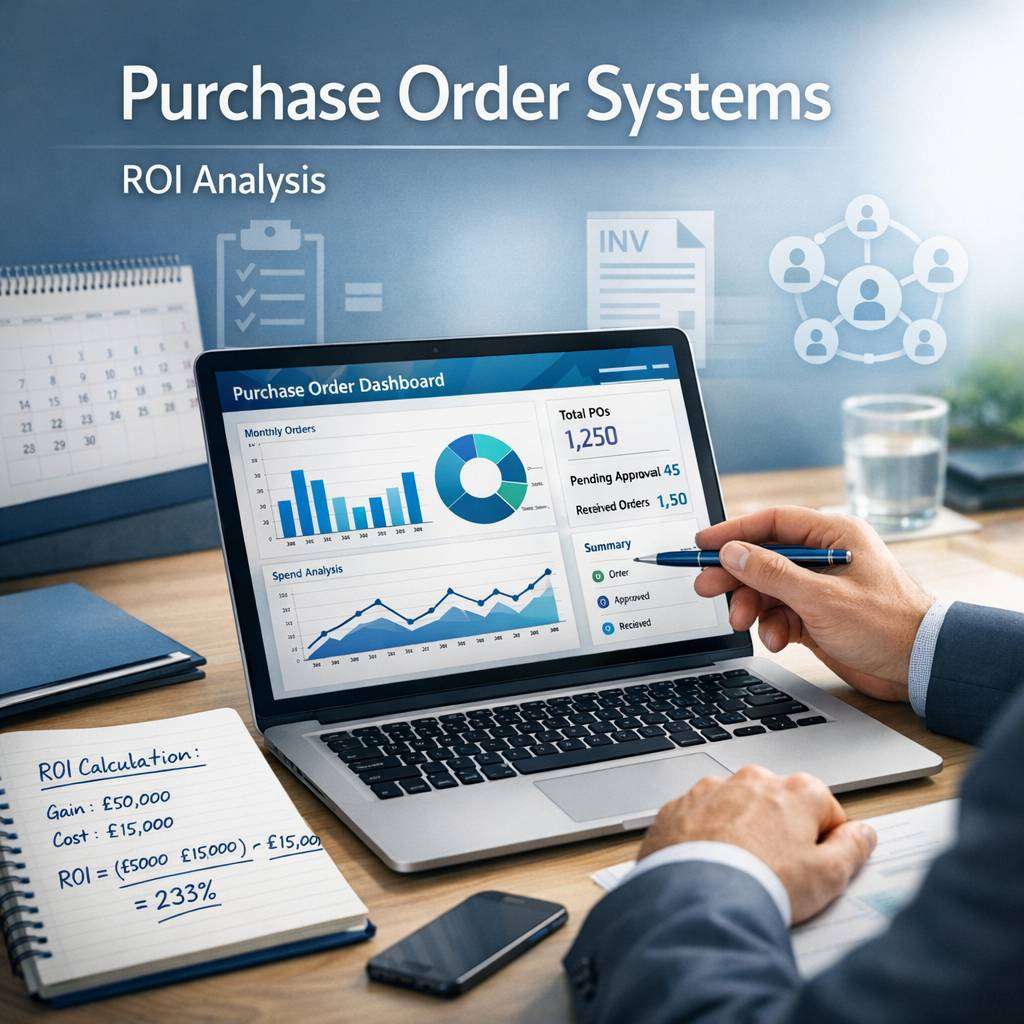
In today’s procurement landscape, organisations are under increasing pressure to reduce costs, improve supplier relationships, and accelerate purchasing cycles. A well-implemented purchase order system is not merely a bookkeeping tool; it is a strategic platform that harmonises purchasing activity across departments, suppliers, and finance. This article presents a practical ROI analysis of adopting a cloud purchase order system and related purchase order management software, with emphasis on the tangible benefits for businesses across the UK and beyond.
The business case for a modern PO system
A purchase order system UK organisations rely on is designed to standardise and automate the lifecycle of a purchase—from requisition to approval, receipt, and payment. Key capabilities typically include:
- PO creation and approval workflows: Automation reduces manual data entry and speeds up approvals, especially when routes are predefined by department, value thresholds, or supplier agreements.
- Real-time visibility: Stakeholders gain live access to PO status, delivery dates, and budget consumption, enabling proactive decision-making.
- Compliance and control: Standardised templates, budget checks, and audit trails strengthen governance and reduce maverick spending.
- Supplier collaboration: Streamlined communication with suppliers improves order accuracy, reduces cycle times, and supports supplier performance metrics.
For many organisations, the initial trigger to invest is a marked gap in control over spend and a fragmented purchasing process. A cloud purchase order system, in particular, removes the friction of on-premises maintenance and enables remote-enabled approval chains, which is increasingly valuable in hybrid or dispersed teams.
A robust purchase order systems solution streamlines procurement, ensuring accuracy, visibility, and control across departments. With automated workflows, businesses reduce errors, accelerate approvals, and improve supplier relations. Integration with ERP and budgeting tools enhances financial coherence. Implementing a scalable system supports growth, compliance, and data-driven decision making, achieving measurable efficiency. Explore this example: https://www.avidxchange.com/products/avidbuy/
Quantifying the return: a practical ROI model
Estimating ROI for a PO system involves comparing the baseline performance against post-implementation metrics. A straightforward model considers three pillars: cost savings, time efficiency, and compliance/visibility. Typical inputs might include annual purchase spend, current cycle times, and the frequency of late or erroneous orders.
-
Cost savings
- Error reduction: Automating data capture and validation decreases invoice discrepancies, which, in turn, lowers manual rework and supplier disputes.
- Maverick spend reduction: Enforced PO requisitioning curbs off-contract purchasing, improving negotiated supplier terms and volume discounts.
- Invoice handling: A streamlined flow from PO to invoice reduces days payable outstanding (DPO) and leverages early payment discounts where offered.
-
Time efficiency
- Cycle time reduction: Standardised approval workflows cut lead times from requisition to order placement, accelerating procurement cycles and freeing staff for higher-value tasks.
- Clerical savings: Elimination of duplicate data entry and paper-based processes lowers administrative burden.
-
Compliance and control
- Budget compliance: Real-time budget checks prevent overspend and support accurate forecasting.
- Audit readiness: A comprehensive digital trail simplifies internal and external audits, mitigating risk.
Cost savings
- Error reduction: Automating data capture and validation decreases invoice discrepancies, which, in turn, lowers manual rework and supplier disputes.
- Maverick spend reduction: Enforced PO requisitioning curbs off-contract purchasing, improving negotiated supplier terms and volume discounts.
- Invoice handling: A streamlined flow from PO to invoice reduces days payable outstanding (DPO) and leverages early payment discounts where offered.
Time efficiency
- Cycle time reduction: Standardised approval workflows cut lead times from requisition to order placement, accelerating procurement cycles and freeing staff for higher-value tasks.
- Clerical savings: Elimination of duplicate data entry and paper-based processes lowers administrative burden.
Compliance and control
- Budget compliance: Real-time budget checks prevent overspend and support accurate forecasting.
- Audit readiness: A comprehensive digital trail simplifies internal and external audits, mitigating risk.
A practical calculation could be framed as:ROI = (Annual net savings from cost reductions + time savings + compliance benefits) / (Annual cost of the PO system and its maintenance)
Illustrative Example
- Annual spend under management: £25 million
- Estimated improvement: 20% reduction in maverick spend; 30% fewer PO inaccuracies; 25% faster cycle times
- Annual system cost (licences, cloud hosting, support): £120,000
- Valued time savings: £180,000
- Reduced error/processing costs: £125,000
- Compliance and audit efficiency: £15,000
- Net annual benefit: £320,000
- ROI: £320,000 / £120,000 ≈ 2.67x
This simplified example demonstrates how a purchase order system can deliver a compelling return, particularly when it is paired with strong supplier collaboration and change management. Cloud purchase order system models further boost ROI by lowering upfront capital expenditure, enabling scalable user licences, and providing predictable monthly costs.
Choosing the right solution: features to prioritise
When evaluating po system software, prioritise features that align with strategic procurement goals. Three sub-areas to consider are:
-
Process automation and workflows
- configurable approval routing based on department, value, or contract terms
- automated PO generation from approved requisitions
- seamless PO to invoice reconciliation
-
Data integrity and visibility
- centralised supplier catalogue and contract terms
- live dashboards for spend analysis, supplier performance, and budget tracking
- auditable trails and exportable reports for finance and governance
-
deployment and scalability
- cloud purchase order system for accessibility and low maintenance
- integration capabilities with ERP, accounting software, and supplier portals
- support for multiple currencies, tax regimes, and regional compliance, including UK-specific requirements
Process automation and workflows
- configurable approval routing based on department, value, or contract terms
- automated PO generation from approved requisitions
- seamless PO to invoice reconciliation
Data integrity and visibility
- centralised supplier catalogue and contract terms
- live dashboards for spend analysis, supplier performance, and budget tracking
- auditable trails and exportable reports for finance and governance
deployment and scalability
- cloud purchase order system for accessibility and low maintenance
- integration capabilities with ERP, accounting software, and supplier portals
- support for multiple currencies, tax regimes, and regional compliance, including UK-specific requirements
In addition, consider the total cost of ownership (TCO) beyond licences. Cloud solutions typically reduce hardware costs and IT overhead while offering flexible, predictable pricing. For organisations operating across multiple sites, a central po system software platform can standardise buying practices and consolidate spend visibility.
Practical considerations for implementation
A successful deployment hinges on people, processes, and platforms.
- Stakeholder engagement: Involve procurement, finance, and end users early. Define clear approval routes, budget checks, and exception handling to prevent resistance during rollout.
- Data migration: Cleanse supplier masters, contracts, and historical POs to ensure accurate and meaningful reporting from day one.
- Change management: Provide training and quick wins to demonstrate value, such as faster purchase approvals or improved order accuracy.
- Integration strategy: Confirm that the chosen system integrates smoothly with existing ERP, invoicing, and supplier portals, including any cloud-based components.
A cloud purchase order system often offers rapid time-to-value, as well as the resilience and disaster recovery benefits of cloud architectures. For organisations evaluating options, a practical trial or phased rollout can help quantify real-world ROI before full-scale adoption.
Keywords and terminology frequently surface during vendor briefings, including purchase order management software, purchase order systems, and purchase order system UK. While terms vary, the underlying objectives remain consistent: streamline purchasing processes, improve financial control, and deliver measurable, sustainable value.
If you are assessing how to begin, map your current PO cycle end-to-end, identify bottlenecks, and quantify the cost of delay. This groundwork will illuminate the specific ROI levers for your organisation and guide a focused evaluation of cloud purchase order system offerings and po system software aligned with your procurement strategy.
Purchase order systems streamline procurement, helping organizations track requests, approvals, and budgets with precision. They reduce manual errors, enforce policy compliance, and improve supplier communication. By automating workflows, teams gain real-time visibility into order status and spend, enabling better forecasting and cost control. Implementing robust purchase order systems supports audit trails, centralized data, and scalable processes for growth. For detailed guidance, visit https://www.osc.ny.gov/state-agencies/gfo/chapter-xia/xi-a3-purchase-orders.
Purchase order systems streamline procurement, boosting accuracy and efficiency across departments. They centralize requests, approvals, and tracking, reducing delays and errors. For more insights, visit https://cloudb2b.co.uk/ to explore scalable options and vendor integrations.
Comments are closed